What Is a Decreased Anion Gap Indicate?
What Is the Anion Gap?
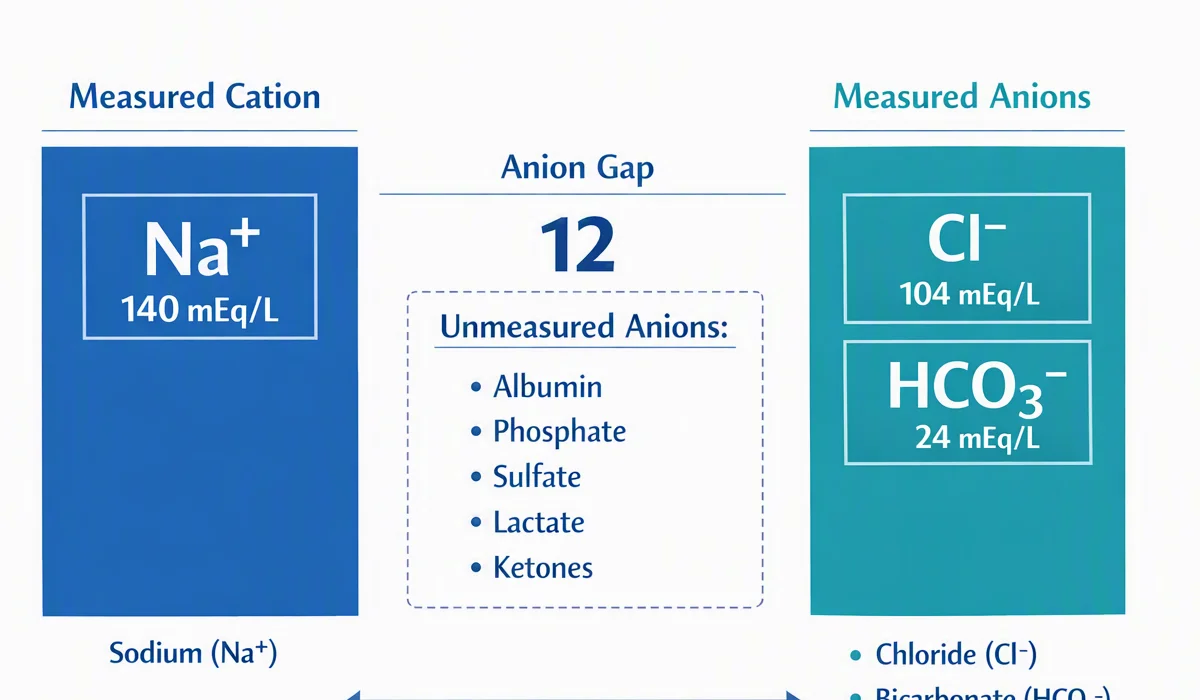
The anion gap is a derived value used to help interpret an electrolytes panel, especially the relationship between positively charged and negative substances in the blood. It is not directly measured. Instead, it is estimated from common lab values such as sodium, chloride, and bicarbonate. As it reflects the interaction between these substances, the anion gap can function as a valuable diagnostic clue when reviewing a laboratory result.
Clinicians often use the anion gap to help evaluate acid-base balance and detect an underlying cause of an abnormal electrolyte panel. It is especially helpful in looking for certain metabolic disorder patterns, such as metabolic acidosis. Although the number itself is simple, the clinical significance depends on the other findings of the lab results and the patient’s overall picture.
Think of the anion gap as a way to account for unmeasured ions in the blood. Some ions are routinely reported on a serum chemistry panel, while others are not. The gap helps estimate whether the balance of those unmeasured ions is shifting in a way that suggests disease, lab artifact, or another explanation.
How an Anion Gap Calculator Works
An anion gap calculator relies on the listed values from a basic metabolic panel or related serum chemistry test to determine the gap. In the standard formula, sodium is compared with chloride and bicarbonate. The calculator does not diagnose a condition on its own, but it can assist users and clinicians rapidly understand whether a result appears below normal, within range, or high.
The basic idea is that sodium is the main measured cation, while chloride and bicarbonate are the main measured anions. By subtracting chloride and bicarbonate from sodium, the calculator estimates the amount of unmeasured ions left over. That number can then be compared with the lab’s reference range or reference interval to decide whether it falls within a expected span.
Many people come across the calculation after receiving results from a routine electrolyte panel. The value is often included automatically in the report, but a calculator can be useful for verifying the math or understanding how changes in bicarbonate or chloride affect the final result. This is why an anion gap calculator is often used as part of blood test interpretation, not as a stand-alone test.
When a result seems unusual, the calculator may help determine whether the issue is truly a low anion gap or whether the result is explained by changes in the other electrolytes. This can be especially helpful in distinguishing a true abnormality from a lab artifact.
What Is Considered a Below-Normal Anion Gap?
A reduced anion gap means the calculated value is under the lab’s expected reference range. Different labs use slightly different methods and instruments, so what counts as low can vary. For that reason the same result may be reported as low in one setting and still be considered within a borderline range elsewhere. This helps explain why lab variability matters when reviewing the number.
In many cases, the most important question is not just whether the value is low, but whether it is persistently low and whether it fits with other findings such as albumin level, sodium, chloride, and bicarbonate. A low result may be temporary, may reflect a benign shift, or may point to a larger issue. A single number is merely one piece of blood test interpretation.
One common reason a low result appears is a low serum albumin level. Albumin carries a negative charge, so when it drops, the calculated gap can drop too. This is why clinicians may consider an albumin correction or a corrected anion gap when interpreting a low result. In that situation, a low value may not reflect a true change in acid-base balance.
It is also useful to compare the number with the person’s typical baseline and with the lab’s reported normal anion gap. A value that is slightly low may not be clinically important, especially if the patient has no symptoms and the rest of the panel is stable. The meaning comes from the broader context, not from the number alone.
Typical Causes of a Low Anion Gap
The primary cause of a low anion gap is hypoalbuminemia, meaning a low blood albumin level. Because albumin is one of the major negatively charged proteins in blood, lower albumin decreases the calculated gap. This can be seen in chronic illness, inflammation, liver disease, malnutrition, or other conditions that lower protein levels.
Another significant cause is multiple myeloma or related disorders that produce abnormal proteins. These proteins may behave as positively charged paraproteinemia and can lower the calculated gap. Sometimes, the low value becomes a quiet clue that prompts further testing for a plasma cell disorder. A persistently low anion gap can thus be a valuable clue, especially when it is paired with anemia, bone pain, kidney issues, or other abnormal labs.
Lithium can also reduce the anion gap. Because lithium is a positively charged ion, higher levels may lower the gap and sometimes create a very low result. This is not the usual explanation, but it is an important one when a person is taking lithium for a psychiatric condition. In that setting, the laboratory pattern may have meaningful clinical importance and may need prompt review.
Less commonly, a low value may be influenced by other unmeasured substances or by a shift in measured electrolytes. However, the main causes to consider are low albumin, paraprotein disorders, and medication-related effects. The key is to look for the underlying cause rather than focusing only on the number itself.
Could a Decreased Anion Gap Result from a Testing Error?
Yes. A decreased anion gap can be caused by measurement error or various testing issues. If the number does not match the clinical picture, clinicians often suspect the possibility of a lab-related problem before concluding disease. This is why a repeat blood test is often recommended when the result is unexpected.
A possible problem is an electrode issue, which can affect how the analyzer reads chloride or other components. If the chloride reading is inaccurate, the calculated anion gap may be incorrectly low. This kind of problem is one form of testing artifact and may be discovered only after the result is repeated or checked on a different instrument.
Sample contamination is another possibility. If the blood sample is contaminated with IV fluid, anticoagulant, or another substance, the electrolyte values may be altered. That can lead to a misleading reduced anion gap even when the person’s body chemistry is normal. Because of this, repeat testing is often the easiest way to sort out a questionable value.
It is important to remember that a single unusual result does not always mean disease. A thorough review of the sample quality, the full electrolyte profile, and any changes from prior results can help determine whether the value reflects true physiology or a technical issue. In many cases, a repeat sample provides the answer.
Symptoms and Associated Lab Abnormalities
A decreased anion gap by itself often brings no signs. The signs, if any, usually stem from the condition behind it. For example, if the low value is related to https://rentry.co/8xz8rg88 kidney disease, a person may also have fatigue, swelling, altered urination, or other lab abnormalities. If it is linked to a protein disorder such as multiple myeloma, there may be ache, weakness, or signs of anemia.
Adjacent lab findings can give valuable context. A low anion gap may appear alongside metabolic acidosis, where the body has too much acid or too little buffering ability. It may also be seen with metabolic alkalosis, depending on the broader electrolyte pattern and the cause of the abnormality. Because the anion gap is part of acid-base balance, it helps focus the differential diagnosis rather than replace it.
Other signs of electrolyte imbalance may include muscle weakness, confusion, cramps, or heart rhythm disturbances. The exact symptoms depend on which electrolytes are altered and how quickly the change occurred. A low anion gap is therefore best viewed as a clue that can help a clinician piece together between symptoms and lab results.
In some situations, the low value is part of a larger pattern of abnormal results on the same basic metabolic panel or serum chemistry test. Checking bicarbonate, sodium, chloride, creatinine, and albumin together can reveal whether the person has a genuine metabolic issue or whether the number is likely to be incidental.
When a Low Anion Gap Needs Medical Attention
A low anion gap may not always need urgent care, but it should be reviewed by a clinician if it is recent, persistent, or paired with symptoms. Medical attention is more urgent when the result suggests an underlying condition such as hypoalbuminemia, multiple myeloma, lithium exposure, or kidney disease. The same is true if the remaining test results are also abnormal.
Follow-up testing is often the next move. This may include follow-up testing of the electrolyte panel, a repeat blood test, and sometimes tests that look more closely at protein levels, kidney function, or blood counts. A complete blood count can be especially helpful if there is concern about anemia, infection, or a bone marrow disorder.
If the low result comes from a known issue like low albumin, the clinician may calculate a corrected anion gap using albumin correction. That can help determine whether the apparent abnormality is in fact due to the protein level. In other words, the low number may be less worrisome after correction, but it still should be interpreted in context.
Get medical review sooner if the low anion gap appears together with symptoms such as severe weakness, confusion, shortness of breath, chest pain, or signs of kidney problems. A low value on its own is not necessarily an emergency, but it can be an important clue that something else needs attention.
Frequently Asked Questions About Low Anion Gap

What is a low anion gap mean on a blood test?
A low anion gap on a blood test means the calculated value is below the lab’s expected normal range or reference interval. It can happen because of low albumin, certain protein disorders, medication effects, or testing issues. Taken alone, it is not a diagnosis, but it can be a useful clue during blood test interpretation.
Does low albumin cause a low anion gap?
Yes. Low albumin, also called hypoalbuminemia, is one of the most common causes of a low anion gap. Because albumin carries negative charge, lower levels can reduce the calculated gap. Clinicians may use albumin correction to estimate a corrected anion gap and see whether the result still appears abnormal.
Can a low anion gap turn out to be dangerous?
Not always. A low anion gap can be harmless or due to lab variability or measurement error. However, it can also point to a condition such as multiple myeloma, paraproteinemia, lithium exposure, or kidney disease. The level of concern depends on whether the finding is persistent and whether other symptoms or lab abnormalities are present.
Is it wise to I repeat the test if my anion gap is low?
Often, yes. A repeat blood test can help determine whether the result was caused by a true medical issue or a lab artifact such as electrode interference or specimen contamination. If the result remains low, your clinician may investigate further for an underlying cause.
Which conditions are associated with a persistently low anion gap?
Conditions linked to a persistently low anion gap include hypoalbuminemia, multiple myeloma, other forms of paraproteinemia, and lithium use. Less commonly, persistent abnormalities can relate to chronic illness, kidney problems, or recurring testing issues. A clinician may order more tests, including a complete blood count, to evaluate the full picture.